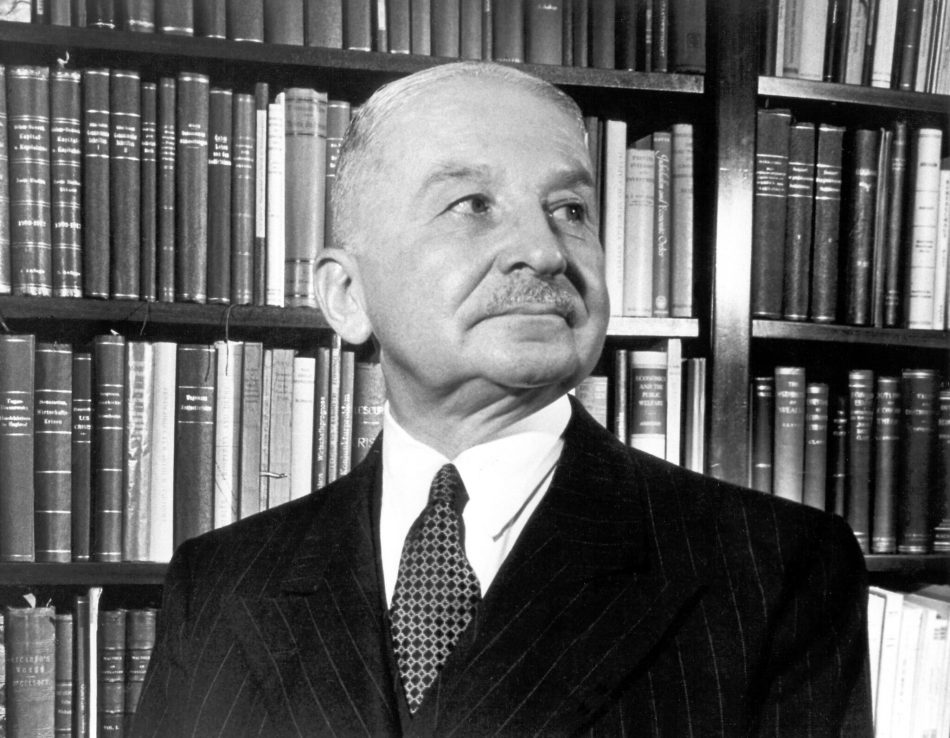
Von Mises, Smith and Friedman are already more present in young people than Marx and Keynes
The Catholic University conducted a survey on the thinkers most cited by specialists in the economic field. Liberals top the list.
One implication stands out above all: That schools bring little influence to bear on a child’s achievement that is independent of his background and general social context; and that this very lack of an independent effect means that the inequalities imposed on children by their home, neighborhood, and peer environment are carried along to become the inequalities with which they confront adult life at the end of school.
Students’ Family Background Matters Read More »
When looking at other states and territories, it is notable that those with the highest net inbound migration are those with the lowest tax burdens, that encourage entrepreneurial activity, that are fiscally healthy, and that have strong economies. Likewise, those with the highest net outgoing migration are those that impose higher tax burdens and more regulations and offer fewer employment opportunities.
Puerto Rican migration in search of economic freedom Read More »
On one side, we have the socialist model: high taxes, high regulation, less competition and declining public services with government imposing itself as the solver and arbiter of all social problems. On the other side, we have the Miami model: low taxes, low regulation and a commitment to public safety and private enterprise. The models present a stark choice on issues ranging from personal freedom, economic opportunity, public safety and the role of government.
Miami Takes On the Socialist Model Read More »
In the letter dated July 30, the Oversight Board attached an extensive study by economist Robert Triest in which the negative impacts that Law 41 would have on the economic development of Puerto Rico are summarized. In short, the economic study concludes that Law 41 discourages the hiring of new employees in the private sector and, therefore, Government revenues will be affected. Specifically, the study concludes that Law 41 will cause a decrease in Government revenues of $156 million in the short term and - in the long term - it will cause a reduction of $8.1 billion in revenues. Based on that study, the Board concludes that Law 41 is inconsistent with the Fiscal Plan and violates PROMESA.
Labor reform changes, next litigation between the Board and the Government Read More »
The ominous disquisitions are already beginning to creep in regarding what the transition from the PAN program, for which Puerto Rico receives $2.5 billion in a block, benefiting more than a million people, to what would be the so-called SNAP, which is the system that prevails in the United States and its territories, thanks to which a substantial increase in aid would be seen, but with one condition: people between 16 and 59 years old, without dependents and able to work, will have to do so, even if it is part-time.
The PAN in block, with butter Read More »
It is fundamental that citizens be educated in the essential concepts and operation of constitutional government and market economies. This way, people could count on basic knowledge about the functioning of politics and the economy, for better economic decision-making and for when exercising their right to vote. Not having knowledge of these issues limits people to judge ideas, policies, proposals, etc. When people are oblivious to economic and political issues, they are not provided with the essential tools to combat and escape ignorance.
Educational freedom as a motor of human potential Read More »
For years, Puerto Rican politicians have complained that forcing the U.S. island territory to rely on American-flagged ships — even with foreign ships in abundance in its ports — drives up the cost of basic goods there. The cost of living is higher on average compared with the mainland.
What is the Jones Act, and why does Puerto Rico want it gone? Read More »
That the Dominican Republic sources most of its fuel from the United States while Puerto Rico—a U.S. territory with American citizens—does not (and cannot in the case of bulk LPG and LNG) is an embarrassing absurdity. Such a distorted state of affairs can only be explained by misguided Jones Act protectionism. Let us hope the island can be exempted from this archaic law so it can make greater use of domestic products and realize much‐needed savings to meet its citizens’ energy needs.
The Jones Act Is Forcing Puerto Rico to Overpay for Energy Read More »
We need to promote laws that encourage the growth of new companies and ecosystems of innovative services. In the near future, the emerging and vibrant economies will be those that enrich and promote the generation of services based on the talent of human capital. We need to transform the talent market and create a legislative framework that facilitates labor flexibility.
Puerto Rico needs a state-of-the-art labor context Read More »