
In the States, the New Deal became a political era. In Puerto Rico, it became an operating system.
My cousin in New York City, who voted for Mamdani, recently asked me why I was thinking about places like Idaho, Wyoming, or the Dakotas. I told him that part of the appeal was not merely ideological, but civilizational. Those places seem like the antithesis of Puerto Rico’s political culture: fewer people, more space, less accumulated government, and less of that suffocating feeling that every private act must first be translated into an administrative procedure. I was half-joking, as usual, but only half. Puerto Rico has a way of turning even ordinary frustrations into political archaeology. You start by asking why a permit takes so long and, before you know it, you are talking about Rexford Tugwell.
That is not as random as it sounds. Tugwell is one of those names anyone serious about Puerto Rico should know, even if only as a symbol. One of President Franklin Roosevelt’s New Deal planners and a member of the so-called Brain Trust, he believed government experts (Columbia University Professors) could rationally organize economic life if given enough authority. Politically radioactive in Washington, he arrived in Puerto Rico as chancellor of the University of Puerto Rico and then as the last governor of Puerto Rico not born on the island, serving from 1941 to 1946. He later wrote The Stricken Land: The Story of Puerto Rico, a title that reveals the mentality: the island was not merely a place to govern, but a problem to be solved from above.
To be clear, the old Puerto Rico was no libertarian paradise. It was poor, rural, hurricane-battered, and locked in a sugar-dominated colonial economy with concentrated land ownership. Much of what passed for order was private power with few restraints. So, the point is not that Washington D.C.’s social policy ruined the island. That would be childish history, and worse, false. The point is more precise and more damning: Puerto Rico received the New Deal not merely as emergency relief, but as a governing philosophy imposed under colonial conditions and then enthusiastically indigenized by local leaders.
The distinction matters. In the States, the New Deal contended with federalism, courts, rival power centers, and voters who could push back. Here, however, it landed where democratic accountability was thinner and the ruler-ruled relationship was already paternal. Emergency instruments like the Puerto Rico Reconstruction Administration addressed real needs: infrastructure, housing, public works, land reform, and relief for a devastated population. But they also entrenched a template, namely, public corporations, planning boards, expert administration, and the assumption that the island’s future had to be designed before its people could be trusted to live it.
Tugwell championed that vision with evident conviction. To him, planning was “a way of bringing the foreseen and agreed future into daily influence on action,” thereby displacing economic groups that, in his view, exploited the public through government.
The formulation is almost beautiful, in the way dangerous sentences often are. It contains intelligence, moral seriousness, and Ivy League condescension in equal measure. It assumes that the future can be foreseen, that agreement can be manufactured, and that daily life should bend to the plan. Local actors, especially under the Popular Democratic Party, embraced and expanded this machinery with Puerto Rican accents. And so, what began as imported technocracy became homegrown managerial dependency.
This is why Tugwell matters. Not because he alone caused every dysfunction that now afflicts Puerto Rico, but because he symbolizes the fusion that still defines us: American progressive technocracy, colonial administration, and local patronage politics. The tragedy is not that planners planned. Every serious society, after all, plans. The tragedy is that emergency tools became permanent institutions, and those institutions shaped a temperament. Progress comes from above. Problems are solved through agencies, permits, plans, and experts. Citizens do not act; they are processed. Public life is not trusted to organize itself; it must be supervised into coherence.
And so that temperament persists. It speaks every time a politician announces a new office, committee, czar, or task force whose primary output is the press conference. It speaks in the habit of mistaking motion for achievement and administrative vocabulary for moral purpose. It speaks in the ritualistic production of government action: create a task force, hold a hearing, or name a coordinator. We do not solve problems so much as proceduralize them.
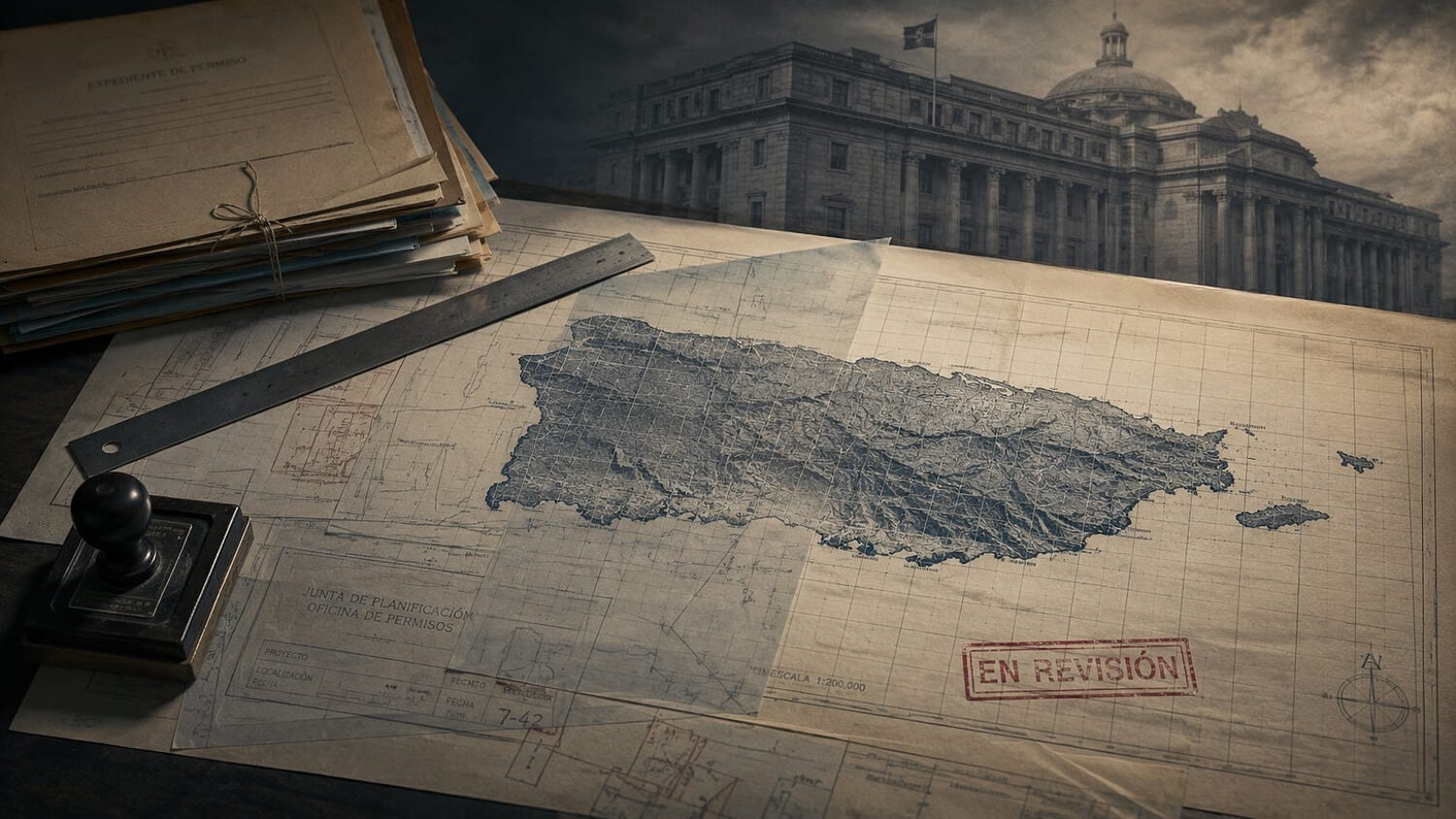
You see it in licensing boards that treat the right to work as an administrative favor. You see it in permitting processes that convert ownership into supplication. You see it when statutory deadlines become suggestions and agencies treat a 30-day clock as something that begins only after the government decides it is ready to start counting. You see it when every administration expands government, but almost none can bring itself to abolish an agency. The problem is not merely that the bureaucracy is slow. The problem is that the bureaucracy has learned to make its own delay part of the law.
The result is a state too weak to reliably maintain roads, schools, hospitals, the electrical grid, or clean water, yet intrusive enough to make opening a small business feel like seeking papal dispensation. The government cannot deliver, but it obstructs beautifully. It cannot provide services worthy of its promises, but it can still demand forms, stamps, certifications, sworn statements, renewals, inspections, and approvals from people who are simply trying to work. This is not socialism. That word flatters it with theory. What Puerto Rico has is managerial dependency: a republic of forms where life must pass through government because government has learned to convert friction into power.
Every party has made peace with the machine. The PPD, the pro-Commonwealth party, gave it the paternal language of uplift, guardianship, and social justice. The NPP, the pro-statehood party, digitizes portals, hires consultants, imports acronyms, and calls modernization what is often only bureaucracy with a cleaner interface. Even conservatives here often campaign like Republicans and govern like New Dealers with better shoes. Both major parties have learned that the administrative state supplies not only ideology, but concrete political resources: jobs, contracts, permits, favors, and delays. The machinery survives because it is useful to the people who denounce it in opposition and inherit it in power. And the status debate supplies a convenient escape hatch. Blame Washington, colonialism, or empire, and defer the harder work of internal self-government. Daily administrative friction, homegrown, signed by local officials, defended by local incumbents, becomes someone else’s fault.
That is not to say, of course, that status is irrelevant. Quite the contrary: It is profoundly relevant. Puerto Rico’s territorial condition has distorted responsibility for more than a century. But it has also given local politics a magnificent excuse to avoid accountability. Although a colonial relationship can explain why our institutions developed abnormally, it cannot justify every absurdity those institutions now impose. At some point, we have to admit that many of the petty humiliations Puerto Ricans suffer are not imposed by distant imperial administrators, but by local stewards of the very machinery they claim to resist.
Bureaucracy here is a tax on possibility. It is a tax on work, time, dignity, and hope. Every needless license teaches that initiative is dangerous without permission. Every duplicative permit tells the citizen that ownership is conditional. Every discretionary approval reminds the entrepreneur that talent matters, but a connection might matter more. And I’m not even getting into taxes here. The upshot is that when lawful action is made pointlessly difficult, a market for shortcuts will always emerge. Corruption is not the opposite of bureaucracy. In systems like ours, it is often bureaucracy’s natural cousin.
The human cost is everywhere. It is the professional who leaves for less humiliating shores. It is the contractor who cannot begin because a file is “under evaluation.” It is the small business owner who spends more energy satisfying agencies than satisfying customers. It is the family that navigates property rules as if ownership were a provisional license granted by the state. These are not isolated tragedies. Rather, they are the system working as designed—just not for the people it was supposed to serve.
A wealthy society can absorb a great deal of administrative stupidity. New York, as I like to remind my cousin, can abuse its taxpayers and still rely on Wall Street, universities, inherited capital, and millions of ambitious people willing to tolerate madness in exchange for opportunity. California can make life unnecessarily difficult and still coast on technology, entertainment, weather, and accumulated wealth. Puerto Rico has no such margin. We imported the administrative ambitions of richer jurisdictions without their cushion of private capital or competitive discipline. Put differently, we imported the appetite without the digestive system.
This is the inheritance we have not fully named. The New Deal did not end in Puerto Rico. It learned Spanish, acquired local patrons, wrapped itself in status debates, and became reflex. When in doubt, create an agency. When criticized, create a plan. When the plan fails, study the implementation. When citizens complain, remind them that the matter is complex and that responsible government requires procedure. A temporary emergency mindset became a permanent permission culture.
Tugwell’s error was not ambition. It was condescension: the sincere, intelligent, lethal condescension of the planner who sees citizens as the raw material of a better future rather than the authors of their own present. Puerto Rico inherited that condescension along with the forms, agencies, and permits. What was once colonial imposition became local reflex. That is the hardest kind of inheritance to break, because by the time the foreign administrator leaves, the local administrator has already learned to think like him.
Breaking that reflex requires more than better policy. It requires recovering the premise Tugwell could never quite accept: that the people who live a life are, in general, better judges of how to live it than the people who plan for them. That a government strong enough to do what only government can do should not obstruct what citizens can do for themselves. That a society is not freer merely because the forms are now online.
Puerto Rico does not need another grand plan announcing the future. We have had enough futures announced to us. It needs a government humble enough to ask, relentlessly, what it is making unnecessarily hard and why. That question, applied consistently, is a reform program.
My cousin in New York might hear this and assume I’m romanticizing empty landscapes and fewer rules. But the appeal of those places is not that they have no government. It is that government there has not yet been trained to treat ordinary life as something that must first be approved. Temperament, once installed, is harder to dislodge than any single agency or rule.
The people are not the raw material of government. They are the reason for it.
This article was written originally under the Substack name The Bauermeister Brief! Feel free to subscribe for free to receive new posts and support his work.