Articles

Congress Can Help Puerto Rico Escape the Food Stamp Poverty Trap

Each year, the U.S. Congress allocates over $400 million for food assistance to support more than 250,000 residents of Puerto Rico who are able-bodied adults without dependents, and are between the ages of 18 and 54. Notably, this financial assistance does not come with a work obligation. Congress does not apply this approach to any of the 50 states, the District of Columbia, or even to Guam and the U.S. Virgin Islands. Beneficiaries of nutritional assistance in these jurisdictions are under the Supplemental Nutritional Assistance Program (SNAP), which includes a work requirement. It's time to bring Puerto Rico into the same program.

Congress Can Help Puerto Rico Escape the Food Stamp Poverty Trap Read More »

Jorge L. Rodríguez
April 9, 2024
trampa de la pobreza

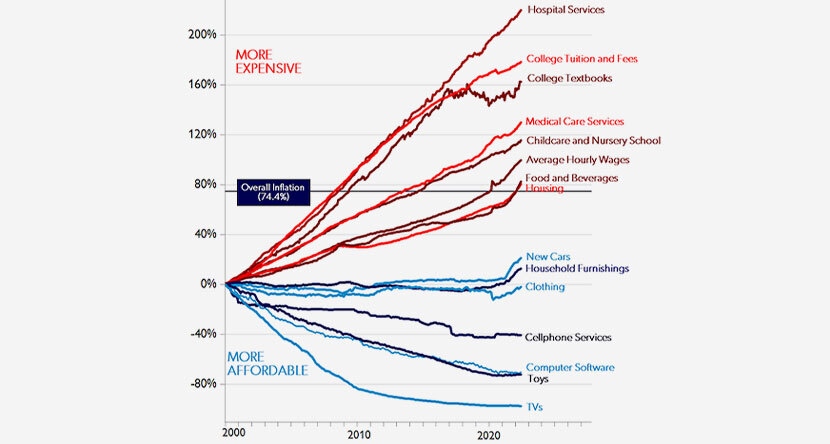
Chart of the Day . . . or Century?

As I wrote in the summer of 2018 on CD, I’ve probably created and posted more than 3,000 graphics on CD, Twitter, and Facebook including charts, graphs, tables, figures, maps, and Venn diagrams over the last 15 years. Of all of those graphics, I don’t think any has gotten more attention, links, re-Tweets, re-posts, and mentions than previous versions of the chart above, which was once referred to as “the Chart of the Century.”

Chart of the Day . . . or Century? Read More »

Mark J. Perry
April 5, 2024

Why Government Unions—Unlike Trade Unions—Corrupt Democracy

Until the 1960s, public employees were organized like lawyers, doctors and other voluntary professional associations. They had no legal right to compel government to enter into contracts. Many already enjoyed civil service protections, and government work was generally sleepy, not ruthless. But public employees had become a huge voting bloc, and leaders of public employee associations wanted power over how government was run.

Why Government Unions—Unlike Trade Unions—Corrupt Democracy Read More »

Philip K. Howard
February 29, 2024

Breaking Barriers: The State Occupational Licensing Index Reveals Opportunities for Occupational Licensing Reform in the US

A new report by the Archbridge Institute finds that occupational licensing creates unnecessary barriers that exacerbate skilled worker shortages and hinder opportunity and prosperity.

Breaking Barriers: The State Occupational Licensing Index Reveals Opportunities for Occupational Licensing Reform in the US Read More »

Patrick M. Brenner
February 26, 2024

The voicing of the Law

Thomas Hobbes is not usually considered a defender of freedom, since his work Leviathan begins with an individualistic interpretation of human beings and their behavior but concludes by advocating a sovereign with absolute power. The lack of restrictions on the power of the sovereign makes him an unsuitable reference for many lovers of liberty; however, this popular perception of Hobbes is not universal in the academy.

The voicing of the Law Read More »

Ojel L. Rodríguez Burgos
February 16, 2024

It's Becoming Easier To Get Permission To Work, But Not by Enough

In Arizona, a new study finds that easing occupational licensing requirements is boosting the state's economy. It's long past time after years of increasing difficulty for people seeking work. "Nearly thirty percent of American jobs require a license today, up from less than five percent in the 1950s," the Federal Trade Commission (FTC) noted in a 2018 report. "For some professions, occupational licensing is necessary to protect the public against legitimate health and safety concerns. But in many situations, the expansion of occupational licensing threatens economic liberty."

It's Becoming Easier To Get Permission To Work, But Not by Enough Read More »

J.D. Tuccille
February 16, 2024
Scroll to Top