

Puerto Rico’s Choice: The Majority Vote for Statehood and the Illusion of “Cadillac Independence”
On November 5, 2024, All Puerto Ricans once again faced a pivotal moment in their island's political history as we all headed to the polls for a non-binding referendum on our political status. Voters were presented with three options that could shape Puerto Rico's future: statehood, free association, or full independence.
However, once the votes were counted, the results reflected a decisive preference for statehood, with 58.61% or 620,782 votes favoring statehood, followed by the option of free association, which would establish a sovereign relationship with the U.S., garnered 29.57% o or 313,259 votes.
Meanwhile, the call for full independence—a vision for Puerto Rico as a completely self-governing nation—received little support, with 11.82% or 125,171 votes.
While the referendum demonstrated a clear majority in favor of statehood, the results reaffirmed the growing momentum for statehood.
It seems that the pro-independence and socialist movement on the Island does not respect these results and does not respect the decisions of the people of Puerto Rico in a fashion typical of most autocratic or communist regimes. We say state this because a group of Pro-Independence, Socialist, and Separatist leaders and lawyers dared to draft an executive order to transition Puerto Rico to Independence, not just any independence, but a "Cadillac Independence," with a $36 billion check from the U.S. for the next 20 years to "develop the country."
Puerto Rico receives substantial net transfers from the U.S. federal government annually. According to data from the U.S. Bureau of Economic Analysis, these net unilateral current transfers were approximately $38.10 billion in 2024, $37.07 billion in 2023, $33.81 billion in 2022, and $38.81 billion in 2021.
Ask yourselves: what sustainable economic development have we achieved?
Puerto Rico enjoys unparalleled access to the world's largest economy, yet we have failed to translate this advantage into sustainable economic development. The numbers tell the story:
- Market Access: as a U.S. territory, Puerto Rico enjoys duty-free trade with a $27 trillion economy integrated into global supply chains under U.S. trade agreements.
- U.S. Citizenship Advantage: With a population of 3.2 million, Puerto Ricans have full mobility within the U.S., providing direct access to a labor market of over 167 million workers and a consumer base of more than 330 million people.
- Massive Federal Support: Over the past two decades, the U.S. has provided over $300 billion in federal transfers, including $120 billion post-disaster relief.
The Missed Opportunity: Where Did We Go Wrong?
Despite these advantages, Puerto Rico has:
- Filed the largest municipal bankruptcy in U.S. history (2017), restructuring $72 billion in debt.
- Lost 696,736, or 18.29% of its population since 2000, as economic stagnation and lack of opportunity pushed people to migrate.
- Failed to generate sustainable private-sector growth, with 65% of the economy still dependent on government spending.
- Maintained one of the lowest labor participation rates in the U.S. at 44.80%, compared to 62.40% nationally, with a shortfall of 39.50%.
Our Problems in One of Competence, Not Status
Puerto Rico, with access to the world's most powerful economy, hundreds of billions in federal aid, and the full benefits of U.S. institutions, has still failed to achieve sustainable economic growth. What makes anyone believe cutting ties with the U.S. would lead to a better outcome?
The challenge concerns sovereignty, leadership, execution, and economic vision. Status alone will not create prosperity until we acknowledge and fix these issues.
Lack of Economic Freedom Leads Into Economic Inequality
Let us peel back the layers of statistics and economic jargon to reveal the human stories at the heart of this pressing issue. It is time to confront the challenges head-on, armed with compassion and an unwavering determination to create a more just and equitable Puerto Rico for all its inhabitants.
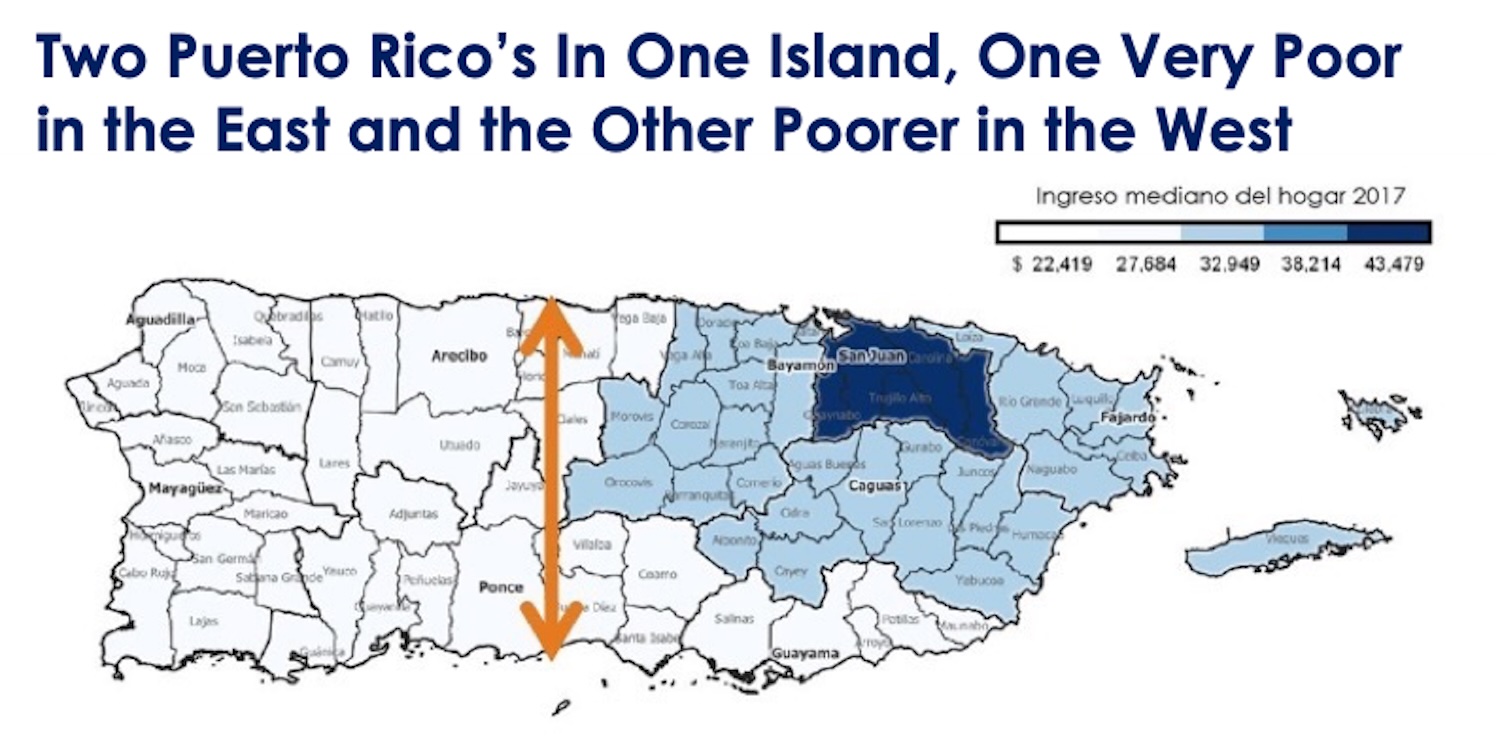
The results are almost incredible if we divide the Map of Puerto Rico into two with an orange line coming down from Manati to Juana Diaz.
The median household income of Puerto Rico, which results to the West, is $22,419 or 30.26% below the U.S. poverty line of $32,150. The Puerto Rico that results to the East has a median household income of $32,949, just 2.48% above the poverty line. The San Juan-Guaynabo area has a median household income of $43,479. Although better off, many places are barely above the poverty line.
> Supplied
The Indicators of Lack of Economic Freedom
Puerto Rico ranks last among U.S. jurisdictions in economic freedom for the second consecutive year; the Island faces structural challenges that perpetuate poverty, stifle innovation, and drive talent away. These indicators paint a clear picture of an economy trapped in stagnation.
- The Cost of Economic Oppression: Puerto Rico scored 2.85 out of 10 in the Economic Freedom of North America 2023 report—placing it well below every U.S. state and reaffirming its position as the least economically free jurisdiction in the country. In contrast, New Hampshire, the leader in economic freedom, boasts a score of 7.96, while the lowest-ranked U.S. state, New York, sits at 4.09—still 43% higher than Puerto Rico. The lack of free-market policies and excessive government regulatory barriers continue to stifle competition.
- The Gini Coefficient of Puerto Rico: the global standard for measuring income inequality is 0.545, exceeding the U.S. average of 0.411 by 24.58%. Reflecting an economy where wealth is concentrated at the top, leaving millions of residents in financial distress.
- Entrenched Poverty: With 43% of its population living in poverty, the disparity is staggering when compared to the U.S. national poverty rate of 11%.
- Income Disparity and Workforce Struggles: with median household income in Puerto Rico is just $22,419, a stark contrast to the U.S., where households earn more than 30% above this figure.
- The Education Divide: According to the National Assessment of Educational Progress (NAEP), Puerto Rican students consistently underperform compared to their U.S. counterparts. Only 27.4% of Puerto Ricans hold a bachelor's degree, compared to 53.7% in the U.S., a lower rate that restricts economic mobility and career advancement.
- The Impact of Natural Disasters: Puerto Rico Rico's ability to hurricanes and earthquakes exacerbates inequality, disproportionately impacting low-income communities. Hurricane Maria in 2017 caused over $90 billion in damages, displacing families, erasing small businesses, and deepening instability.
- A Struggling Private Sector and Lack of Economic Diversification: Puerto Rico remains overly reliant on federal aid and a handful of industries, making it vulnerable to external shocks. Expanding entrepreneurship, renewable energy, technology, and tourism is crucial to fostering long-term economic stability.
- An Overburdened Social Safety Net: With over 44% of Puerto Ricans in poverty, social safety programs are stretched thin. More than half of the Islanders live below the poverty line, highlighting an urgent need for targeted reforms in housing, healthcare, and job training programs.
Economic Freedom: The Path to Prosperity in Puerto Rico
Imagine a Puerto Rico where businesses thrive, investments pour in, and innovation flourishes—a place where economic freedom unlocks unprecedented opportunities for growth and prosperity. Economic freedom is more than just a policy preference; it is the foundation for increased wealth, higher living standards, and a dynamic economy that benefits all.
- A Thriving Business Environment: Entrepreneurs find it easier to start and grow businesses when regulations are streamlined, and taxes are kept at competitive levels while fostering a culture of innovation and job creation.
- Attracting Investment and Capital: A freer economy signals stability and predictability, two key factors attracting domestic and foreign investors. When government intervention is minimal, and policies are transparent, investors are more confident in committing capital.
- Markets That Work Efficiently: Markets function more efficiently when the government allows supply and demand to dictate prices rather than imposing controls. Businesses can allocate resources where needed most, reducing inefficiencies and ensuring that capital is directed toward its most productive uses.
- Fueling Competition and Innovation: Economic freedom lowers barriers to entry, encouraging businesses to compete. Companies strive to offer better products, lower prices, and improved services in a competitive market, benefiting consumers while driving the economy forward. This cycle of innovation leads to greater productivity and long-term economic expansion.
- Protecting Property Rights and the Rule of Law: A stable and reliable legal system that protects property rights is essential for fostering confidence among businesses and individuals. When entrepreneurs and investors know their assets and contracts are secure, they are more willing to take risks, invest, and contribute to economic progress.
- Unleashing Entrepreneurial Potential: Individuals are more inclined to pursue their entrepreneurial dreams by reducing regulatory burdens. Whether launching a startup, expanding a family business, or developing groundbreaking technology, a freer economy empowers individuals to create wealth while contributing to broader economies' diversification and resilience.
- A more efficient government that prioritizes economic freedom is likely to be more efficient and has less corruption and waste. Instead of overregulating businesses and stifling growth, it focuses on creating an environment where innovation and commerce can thrive.
- A Higher Standard of Living for All: The outcome of economic freedom is prosperity. Countries and regions with strong economic freedom consistently enjoy higher incomes, better job opportunities, and greater access to goods and services. A Puerto Rico that embraces these principles would see increased wealth, reduced poverty, and a more vibrant economy.
Economic freedom is not a theoretical concept but a proven driver of wealth and progress.
The Illusion of "Cadillac Independence" and the Lessons of History
The future of Puerto Rico's status is at the center of debate, but history offers a sobering guide to what a drastic shift could mean. Those advocating for a so-called "Cadilac Independence," supposedly with sustained economic benefits and continued U.S. citizenship, may ignore past transitions' historical realities.
The Lessons of History: The Aftermath of 1898
When Puerto Rico transitioned from Spanish rule to U.S. control following the Spanish-American War of 1898, the Island endured a series of economic and political shocks that reshaped its destiny:
- Currency Devaluation & Economic Shock – The imposition of a U.S. exchange rate devalued the Puerto Rican peso by 40%, wiping out savings and drastically reducing purchasing power.
- The collapse of Property Values – Land values plummeted by an estimated 60%, exacerbated by new tax structures that made property ownership unsustainable for many.
- Debt Crisis & Land Loss – Small landowners, especially farmers, faced foreclosures as falling incomes left them unable to meet their obligations.
- Legal and Citizenship Limbo – Puerto Ricans became neither full Spanish nor U.S. citizens, existing in a precarious legal state until the Foraker Act of 1900, establishing a civilian government but withholding U.S. citizenship.
- Economic Takeover – U.S. corporate interests quickly dominated the sugar industry, transforming Puerto Rico into a monoculture economy that relied on imports for food—an issue that persists today.
- Political Uncertainty – The lack of a defined path to statehood, independence, or full integration created a political stalemate that continues to shape the Island's status debates.
- Migration and Citizenship Concerns – If Puerto Rico were to decolonize today, an estimated 2.1 million Puerto Ricans could seek to migrate to the U.S. However, since Congress granted citizenship (through the Jones Act of 1917) rather than the Constitution, it remains a legal question whether it could be revoked.
These historical events are a stark reminder that transitions in sovereignty are rarely smooth or beneficial in the short term. Those advocating for a break from the United States must reckon with the economic, political, and social upheaval such a change could bring.
The Final Word: A Political Tipping Point: Statehood on the Horizon?
While some voices push for an independence model based on unrealistic assumptions, the political reality tells a different story. Just last week, over 100 Puerto Rican leaders—including the Governor, the Senate President, and the Speaker of the House, all prominent Republicans—held high-profile meetings in Washington, D.C. They engaged with U.S. Senators, members of Congress, and Cabinet Secretaries to discuss the Referendum results.
The push follows the results of the 2024 referendum, in which a majority of voters chose statehood.
The notion of a "Cadillac Independence" that maintains the best of both worlds is an illusion unsupported by historical precedent or legal certainty. As the Island moves forward in its quest for political clarity, the lessons of 1898 should not be ignored.
This article was originally published in The Weekly Journal.