
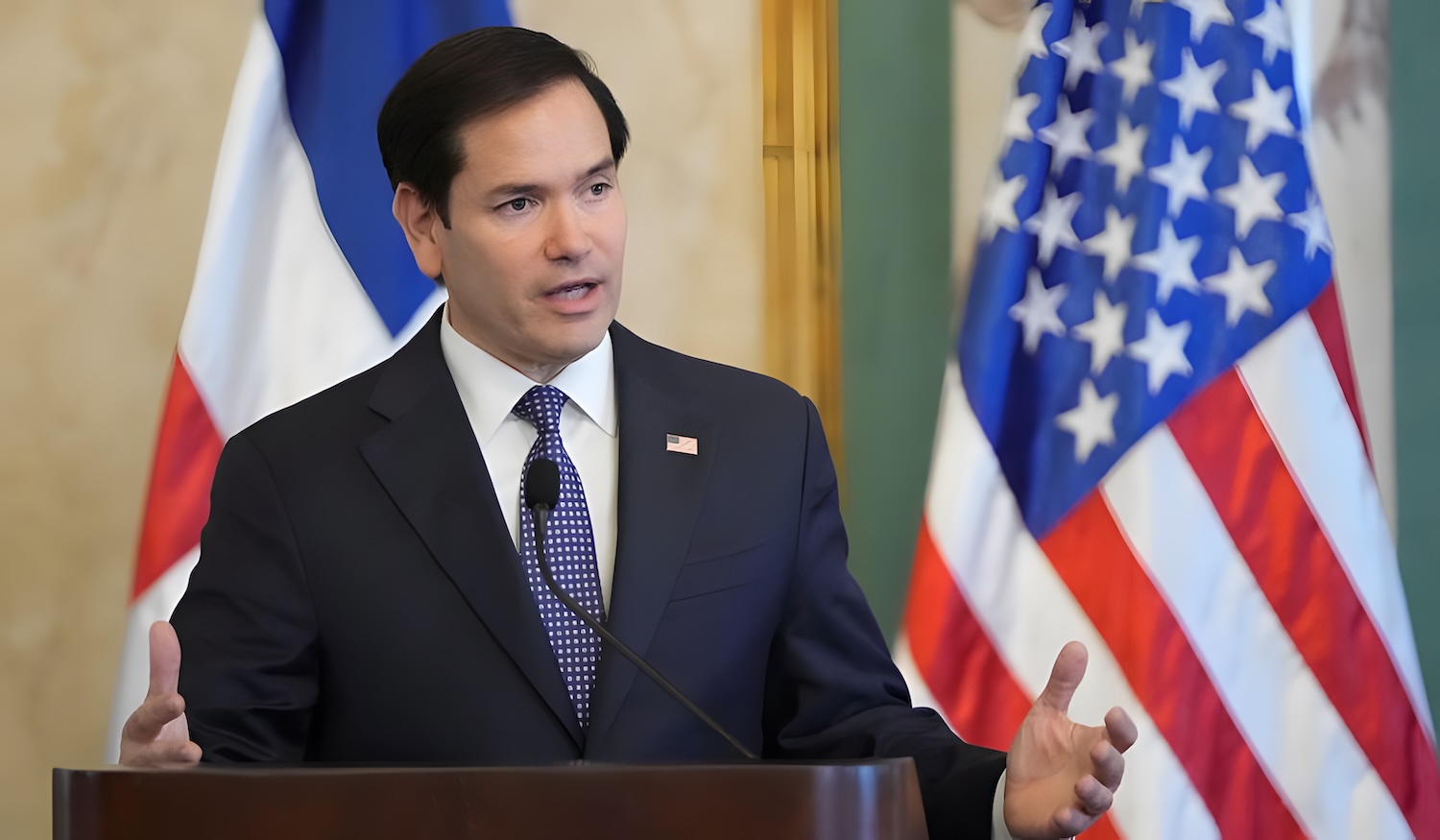
Secretary of State Marco Rubio gives a joint news conference with Dominican Republic President Luis Abinader at the National Palace in Santo Domingo, Dominican Republic, February 6, 2025. (Mark Schiefelbein/Pool via Reuters)
The United States should not only stand its ground in the Western Hemisphere but also lead it to a new era of freedom and prosperity.
With Secretary of State Marco Rubio’s appointment as national security adviser, and President Donald Trump’s recent comments about Rubio’s chances to be his successor, the secretary of state has the unique chance to draft a foreign policy where “America First” means leading in our own hemisphere. That is, the second Trump administration should marry nationalist priorities with regional leadership. Call it the “Rubio Doctrine,” a 21st-century updating of James Monroe’s famous warning to Old World powers to stay out of our backyard. An America First agenda can now be strengthened by renewed engagement with our near neighbors.
Economic Opportunity and Friend-Shoring
Latin America is a sleeping economic giant that aligns perfectly with U.S. “friend-shoring” goals. Rather than relying on factories an ocean away, we can shift supply chains from Asia to the Americas. This isn’t wishful thinking; companies are already eyeing Latin America as global firms seek to decouple from China. The Western Hemisphere boasts resources and capacities the U.S. vitally needs.
For example, roughly 60 percent of the world’s identified lithium reserves are in Latin America, mostly in Bolivia, Argentina, and Chile. Likewise, Brazil holds the third-largest reserves of rare earth minerals globally, which are essential for everything from smartphones to fighter jets.
Venezuela’s largest proven oil reserves could serve as an energy hub for the continent, particularly if that country can be freed from the demagogic ruling class’s tenuous grip on power. Tapping these resources through closer trade ties would strengthen U.S. industries and reduce dangerous dependence on China, which today supplies the vast majority of rare earths.
Recent trade dynamics give the U.S. new leverage to make this happen. The Trump tariffs on Chinese goods — even after the “golden age” trade deal — have raised the cost of outsourcing to Beijing, incentivizing production to move closer to home. Beijing has even tried to dodge U.S. duties by routing exports through “friends” in Latin America and Southeast Asia, proving that supply chains will reorient when costs rise. This friend-shoring would fortify U.S. supply lines against global shocks and create growth across the Americas. It’s a win-win: we reduce reliance on a strategic rival while our neighbors gain jobs and investment, knitting the hemisphere closer together.
Importantly, as Western Hemisphere markets prosper, the economic drivers of illegal immigration weaken, advancing U.S. border interests. At the same time, this approach signals to the world that we prioritize commerce with aligned nations, reducing dependence on anti-American regimes that seek to challenge U.S. global leadership. Recent moves, such as U.S. pressure that convinced Panama to quit China’s Belt and Road initiative, show that assertive American leadership can swing the pendulum.
Political Alliances with Freedom-Minded Leaders
The Western Hemisphere is experiencing a renaissance of pro-American, pro-freedom leadership. Javier Milei in Argentina, Daniel Noboa in Ecuador, and (potentially) María Corina Machado in a post-Maduro Venezuela represent a new generation of Latin American leaders who share our values and fervently oppose socialism. Rubio himself has pointed to these “bright spots,” urging that we “draw inspiration from the new generation of potentially pro-America leaders in the Western Hemisphere.”
Milei ran on an unabashedly pro-liberty platform, which makes him not just an ideological ally, but a willing partner in rolling back the leftist populism that has crippled the continent. Noboa, meanwhile, campaigned on closer alignment with Western allies and has explicitly sought U.S. support to stabilize his nation. His victory over a China-friendly, anti-U.S. opponent was a clear mandate for engagement with Washington. Noboa is already signaling loyalty, going so far as to prepare a port for U.S. anti-narcotics forces and integrating U.S. intelligence to fight gangs.
These freedom-minded leaders can become force multipliers for U.S. influence: voices in international forums who will stand up for democracy in the region, counter Beijing’s overtures, and prove that shared values can underpin durable partnerships. Secretary Rubio has outlined a strategy of collaborating with countries such as Ecuador, El Salvador, Argentina, Paraguay, and Costa Rica — all led by or electing pragmatists who reject the Caracas-Havana model. Instead of lecturing our neighbors about abstract ideals, we would be coordinating with presidents who are already aligned with U.S. principles of free markets and representative government.
Security and Authoritarian Rollback
The final pillar of a Rubio Doctrine is perhaps the most consequential: actively supporting the democratic transition of the hemisphere’s remaining socialist regimes — Cuba, Nicaragua, and Venezuela — through economic leverage, political solidarity, and assertive diplomacy. It’s time to finish the job and usher these regimes into the dustbin of history. The lynchpin is Venezuela: supporting regime change in Caracas is the strategic key to collapsing the entire authoritarian network. A post-Maduro Venezuela would deprive Cuba of its lifeline of subsidized oil, one worth tens of thousands of barrels a day that Havana depends on to prop up its failing economy. Nicaragua’s strongman, Daniel Ortega, isolated and devoid of Venezuelan support, would likewise find his position untenable as democratic momentum sweeps the region. This domino effect would represent the greatest expansion of freedom since the end of the Cold War.
Just as the U.S. has a partner in Taiwan to counter China’s influence in Asia, China has Cuba and Venezuela to assist with its mischief near American shores. These Latin American regimes are also beachheads for adversaries such as Iran and North Korea, as well as for terrorist organizations. China and Russia have eagerly bolstered these chaos agents with loans, surveillance technology, and military cooperation. Beijing has built spyware networks for Maduro and reportedly set up intelligence facilities in Cuba. Toppling these regimes would dramatically curtail this malign influence. It would send an unmistakable message to Beijing that the Americas are off-limits to authoritarian meddling — a modern reaffirmation of Monroe’s old principle.
Moreover, restoring the rule of law in these countries addresses urgent crises that directly impact American communities. Venezuela’s collapse under Maduro has driven nearly 9 million refugees to flee, so removing Maduro would be Trump’s best self-deportation policy. The chaos has also allowed ultra-violent gangs such as Tren de Aragua to spread into U.S. cities. A stable, democratic Venezuela would stem this humanitarian disaster and enhance regional security, easing migration pressures and cutting off criminal cartels. Rubio, with his long record on the Senate Foreign Relations Committee and deep roots in anti-authoritarian advocacy, is uniquely positioned to craft a doctrine grounded in both moral clarity and strategic realism. By taking decisive action across the hemisphere, Rubio could surpass the legacy of Henry Kissinger — the last man to serve simultaneously as national security adviser and secretary of state.
A Hemispheric Realignment Under Trump’s Leadership
American policymakers shouldn’t view Latin America as an afterthought. It’s our strategic home turf and, under a revitalized Rubio Doctrine, it can become the centerpiece of an America First foreign policy. This doctrine recognizes that U.S. leadership and American self-interest are not contradictory; they are complementary.
By friend-shoring industry to Latin America, we strengthen our economy and draw our neighbors closer. By allying with pro-freedom leaders, we amplify our values and influence. By helping nationalists topple tyrants, we make the hemisphere safer for all. Paradoxically, the second Trump administration could become the most Latin America–focused U.S. government in decades — in a good way.
Critics will call this ambitious. But so was the Monroe Doctrine. Yet we remember Monroe’s bold stance 200 years later because it worked: Europe largely stayed out of the Americas.
Today, the challenge is not European empires but Chinese and Russian encroachment and homegrown tyranny. The United States should not only stand its ground in the Western Hemisphere but also lead it to a new era of freedom and prosperity. It’s an unapologetic assertion that our backyard matters more than distant battlefields, and that helping Latin America succeed is integral to putting America first.
An America First approach, applied to the Western Hemisphere, would ensure that when our neighbors thrive and stand with us, America thrives too. As 2025 unfolds, conservatives have a rare chance to redefine hemispheric policy with clarity and conviction. The Rubio Doctrine offers a path forward: principled, pragmatic, and proudly American.
Ilya Shapiro is a senior fellow at the Manhattan Institute who has spoken all over Latin America and whose latest book is Lawless: The Miseducation of America’s Elites. Santiago Vidal Calvo is a collegiate associate at MI and a TPP scholar at Georgetown University’s McCourt School of Public Policy.
This article was originally published in by National Review.