
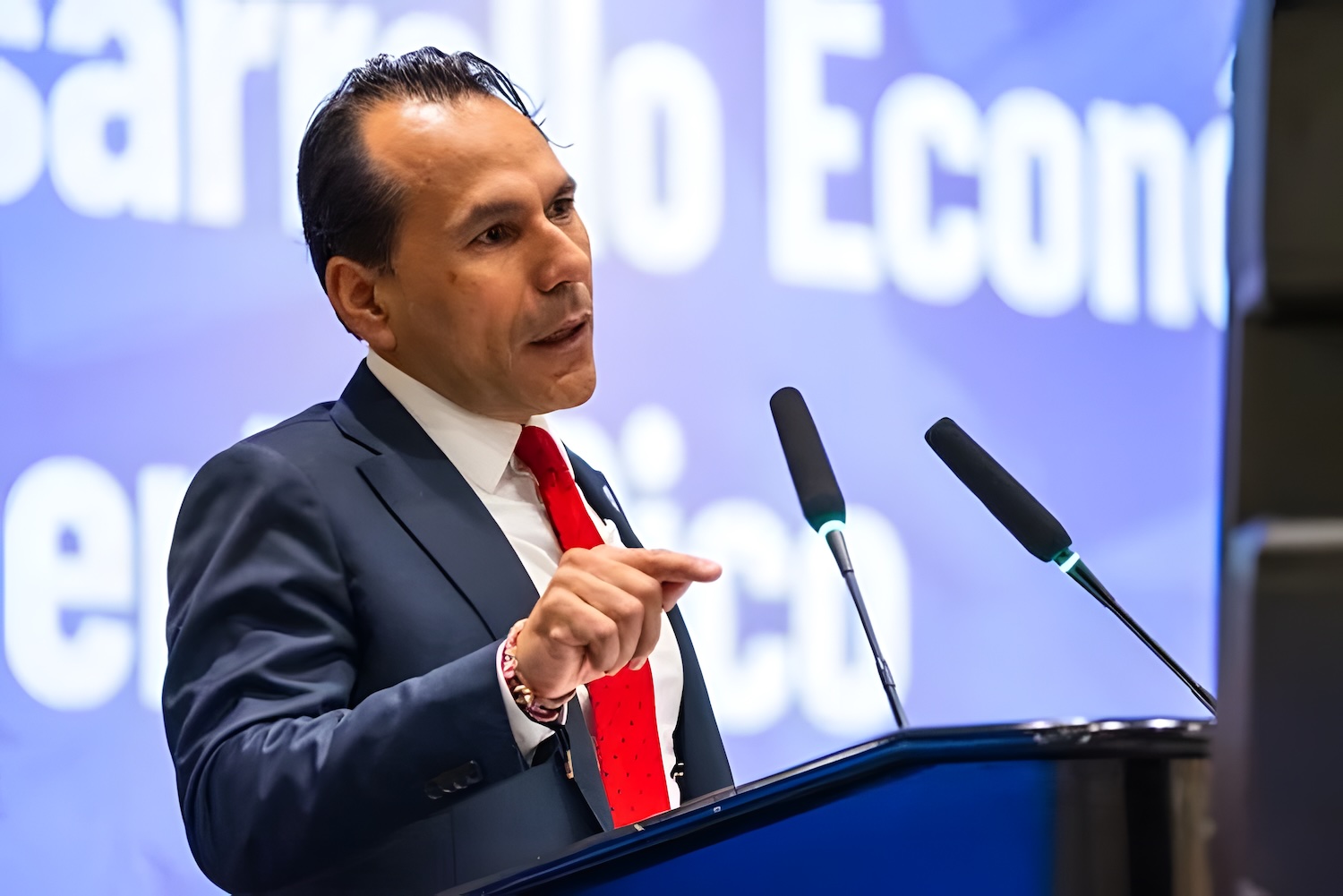
During his participation in the Economic Development Summit of the United Retailers Association, the Executive Director of the Fiscal Control Board, Robert Mujica, recalled that the mission of the Promesa Act is to prevent Puerto Rico from falling into practices that led it to bankruptcy. Yadiel Perez / EL VOCERO
The executive director of the Junta de Control Fiscal (Fiscal Oversight and Management Board), Robert Mujica, warned that tax deductions are under close review as part of the ongoing debate over reforming Puerto Rico’s Internal Revenue Code.
Mujica described Puerto Rico’s tax system as an “enormously complex” framework with more than 150 credits, compounded by multiple incentive decrees, which he said fuels the informal economy.
If we want to lower tax rates, we have to do so within the tax base, since it is necessary to finance budgets, especially the provision of services such as education and health care. This does not necessarily require new sales taxes, since we can also eliminate certain deductions and credits (tax credits).
Robert Mujica
Executive Director, Oversight Fiscal Board
“If we want to lower tax rates, we have to do so within the existing revenue base, because budgets must be funded—especially essential services such as education and healthcare. This does not necessarily require new sales taxes; we can also eliminate certain (tax) deductions and credits,” Mujica told El Vocero after speaking at the 2026 Economic Development Summit hosted by the Centro Unido de Detallistas (CUD, United Retailers Association), held yesterday at the Embassy Suites by Hilton San Juan Hotel & Casino.
As recently as last year, Section 6060.05 of the Puerto Rico Incentives Code was amended to clarify provisions governing the tax exemption on the sale of real estate that serves as the seller’s primary residence. Lawmakers also increased the deduction for contributions to Individual Retirement Accounts (IRAs) in Puerto Rico and raised the maximum annual deduction for contributions to education savings accounts from $500 to $1,000.
Key figure
More than $18 billion
Estimated revenue losses from Act 60 between 2024 and 2030, according to the Departamento de Hacienda (Department of Treasury).
Those measures add to five other tax initiatives approved during the current four-year term, including exemptions for nonprofit entities, uniform filing requirements, exemptions on residential rental income, simplification of Impuesto de Ventas y Usos (Sales and Use Tax) collections, and a tax exemption on prescription medications.
Meanwhile, Act 22—now folded into Act 60 of the 2019 Incentives Code—offers 100% exemptions on interest, dividends, and capital gains, without requiring investment or job creation.
The Treasury Department’s Tax Expenditure Report, published in June 2025, projected that revenue losses tied to Act 60 will exceed $18 billion between 2024 and 2030.
A separate study by the Instituto de Libertad Económica, titled Taxes in Puerto Rico: Structure, Tax Burden, and Comparison with the United States, found that 1,236,709 individual income tax returns were filed in tax year 2023. Of those, 56.2% (695,568) claimed the earned income credit, representing total disbursements of $1.303 billion.
The report—authored by the Institute’s director of research and policy, Ángel Carrión-Tavárez, and former president of the Asociación de Economistas de Puerto Rico, Edwin R. Ríos—also notes that total General Fund revenue from income taxes reached $7.424 billion in fiscal year 2023. Individual income taxes accounted for the largest share, at $3.403 billion, or 45.8%. That figure is calculated before deducting the government’s $448 million share of the earned income credit.
Fiscal responsibility
Mujica emphasized that the central purpose of PROMESA Act is to restore Puerto Rico’s fiscal responsibility and prevent a return to the practices that led to bankruptcy. From 2000 through 2016, the central government spent more each year than it collected in revenue.
“What we have done so far is stop the bleeding. Now we are trying to create a sustainable model for when the fiscal board is no longer in Puerto Rico,” Mujica said. He urged retailers to join what he acknowledged will be a difficult conversation, given that eliminating certain credits would affect specific sectors.
Reshaping the tax structure
For his part, CUD president Ramón Barquín III said Puerto Rico needs “structural reforms to the economy,” including an overhaul of the tax code to reward work and penalize evasion.
“What is needed is a broad and unprecedented labor reform that does not penalize employers, but instead gives them the tools to pay adequate and fair wages within the supply-and-demand dynamics through which the market regulates itself,” said the financial analyst.
Barquín also called for fiscal reform to “reduce the size of government and pursue agility, efficiency, and profitability.” “That requires adopting modern digital communications technology and recognizing that government should not be the true engine of the economy or the main employer. Economic development belongs to the private sector, and government intervention should be kept to a minimum,” he added.
The CUD president stressed that tax reform must be evaluated alongside the budget process and other factors shaping Puerto Rico’s economic development.
“It is essential to look at this holistically—using a medical analogy—because the patient is in a comatose state and the full scope of what will be affected must be considered. In the absence of structural reform, with a government that heavily influences the cost of doing business and a lack of momentum behind growth aspirations, we end up with the economic reality of our jurisdiction, which remains the poorest within the United States,” he concluded.
This article was originally published in Spanish by El Vocero.