
Ángel Carrión-Tavárez and Ojel L. Rodríguez Burgos
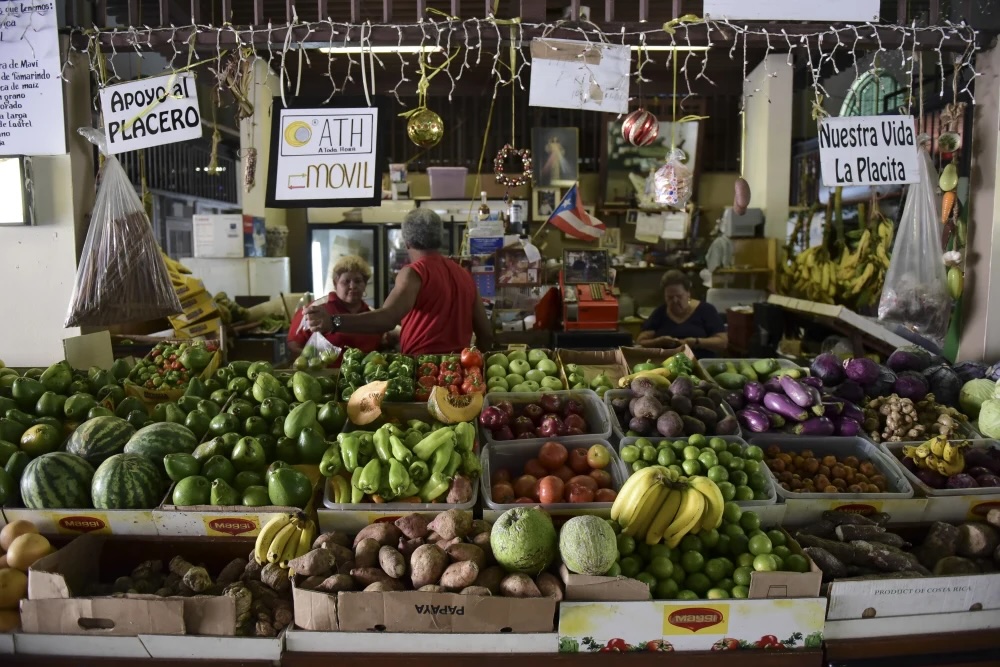
Photo: A produce stand at La Placita de Santurce farmers' market that sells mostly locally grown produce in San Juan, Puerto Rico. (AP Photo/Carlos Giusti)
One of Friedrich August von Hayek’s best-known and most important contributions to political and economic theory is his book The Road to Serfdom, published in 1944. The book was written against the backdrop of the 1930s and 1940s, a period marked by the rise of ideologies such as nationalism, fascism, and communism, as well as by growing state intervention in Western economies. The central thesis of the book is that Western societies were abandoning “the individualist tradition which has created Western civilisation.”[1]
Hayek argues that the West had gone astray in believing that prosperity could be achieved through greater government control of the economy. In his view, this trend threatened both individual freedom and prosperity.[2] By contrast, Hayek maintains that a general increase in wealth depends on a system based on the free market and a society of free individuals; he therefore concludes that “The guiding principle, that a policy of freedom for the individual is the only truly progressive policy, remains as true today as it was in the nineteenth century.”[3]
This view of individual freedom in society and the market does not mean that Hayek denies the need for a role for government. Hayek recognizes that government has legitimate functions in areas where the market cannot, on its own, provide certain goods, services, or conditions necessary for the functioning of society.[4] An analysis of The Road to Serfdom allows us to distinguish three areas in which Hayek recognizes a legitimate role for government: the rule of law, functions that fall within the government’s constitutionally assigned powers, and activities whose provision may be economically costly for the free market.
The Rule of Law
The rule of law is of great importance to Hayek, as he considers it essential to a truly free society.[5] The state has the function of “fixing rules determining the conditions under which the available resources may be used, leaving to the individuals the decision for what ends they are to be used.”[6] In this way, the rule of law allows individuals to live and cooperate within civil society, where they can pursue their own conception of the good life.
The role of government under the rule of law also permits certain general regulations of the market, particularly with regard to lawful methods of production. “To prohibit the use of certain poisonous substances, or to require special precautions in their use, to limit working hours or to require certain sanitary arrangements, is fully compatible with the preservation of competition.”[7] Hayek also identifies other areas in which the government may intervene, such as preventing fraud and protecting the environment.[8]
The authority derived from the rule of law is not unlimited, nor does it give the government carte blanche to regulate indiscriminately every area of the economy and our lives. Hayek establishes several principles to limit government intervention: “The only question here is whether in the particular instance the advantages gained are greater than the social costs which they impose.”[9] This principle implies that regulations must be justified by the benefits they produce and must not impose social costs that outweigh those benefits. In particular, regulations should not unnecessarily hinder free competition in the market. The rule of law must also preserve competition not only domestically but internationally.
An example in Puerto Rico is the regulation issued by the Negociado de Transporte y Otros Servicios Públicos (Bureau of Transportation and Other Public Services) to establish the rates to be paid to private truckers. This regulation grants the government the authority to arbitrarily set transportation rates between parties that have reached a private agreement. This type of regulation limits the freedom of the parties to negotiate contracts and may restrict competition by increasing the costs incurred by those who require transportation services—costs that may ultimately be passed on to consumers. Moreover, it may become a protectionist measure benefiting the private interests that dominate the transportation market by shielding them from competition from providers capable of offering the service at lower costs.
Another principle of the rule of law is that government action must not infringe upon or diminish individual freedom. For Hayek, the state cannot control the means or instruments through which individuals pursue their desires and purposes, including, above all, the pursuit of the good life;[10] therefore, the rule of law must establish a framework that allows individuals to pursue their own ends rather than impose the means by which they must achieve them. In this sense, the rule of law does not seek to direct individuals’ decisions, but rather to establish general rules that allow them to act freely and coordinate their activities with those of others.
Constitutional Powers
Constitutional powers represent another dimension of the role of government. Although Hayek does not explicitly develop this concept in The Road to Serfdom, it can be inferred from his broader argument. This principle means that the government is limited to intervening in those areas assigned to it within the constitutional framework. This limitation introduces the second area in which the government may perform functions that the free market cannot necessarily undertake; the primary example is national defense. In many constitutions, responsibility for national defense is assigned to the government; accordingly, the government has a role in creating and maintaining armed forces to protect the country against external threats.
The recognition of this constitutional responsibility does not preclude the free market from participating in the provision of services related to security and defense; there are many private security companies that provide protection services to both individuals and the state. Likewise, in the case of the U.S. Postal Service, whose existence stems from a constitutional mandate to establish post offices and postal routes,[11] companies such as FedEx, DHL Express, and UPS have emerged to provide delivery services that compete with the government’s postal services. In any case, when the Constitution assigns a responsibility to the government, the government must have the institutions and resources necessary to fulfill it.
Areas of Low Profitability
The final situation in which Hayek sees a necessary role for government concerns areas where it is too costly for the free market to provide certain services. These are services that the free market does or could provide, but that, under certain circumstances, it may not be economically efficient to provide throughout the economy or in particular areas or localities. An example in Puerto Rico is internet access and the PrepaNet network.
PrepaNet was a subsidiary of the Puerto Rico Electric Power Authority (PREPA) that, through its access to PREPA’s infrastructure, was able to enter the telecommunications market by developing a fiber-optic network to provide the infrastructure needed by the private sector. This infrastructure was used to reduce the digital divide in Puerto Rican communities that lacked private alternatives because, for companies, making the necessary capital investments in areas with low demand and low profit margins was too costly.
This government initiative facilitated the entry of private businesses into the market and the provision of this important service. In this case, government participation can be considered permissible because it facilitates the provision of the service without necessarily replacing the private sector, while giving individuals in these communities greater opportunities to pursue their own ends and engage in activities that contribute to their conception of the good life. These ends and activities may include staying informed, obtaining an education, starting an online business, or developing local economic activities.
The fact that the government provides services in areas where doing so is costly for the free market does not mean that this power is without limits. Any government action intended to provide services should be assessed according to whether it affects competition in the market. Government provision of a service should not prohibit or make it more costly for private businesses to enter that market. Government participation, therefore, should neither displace nor impede private initiative, but should be limited to circumstances in which it is necessary to make the service available, while seeking to ensure that private actors assume responsibility for delivering it when market conditions allow.
Likewise, no government action should undermine individual freedom. Any service provided by the government should be evaluated according to whether it expands or restricts individuals’ ability to freely pursue their own conception of the good life. The function of government is not to determine what ends individuals should pursue or to decide how they should achieve them, but rather to create the conditions that allow them to use their own knowledge and resources to pursue those ends freely, within the framework of the law. Even when government intervention is justified by the circumstances, it must remain within parameters that preserve individual autonomy and prevent the government from substituting its decisions for those that properly belong to individuals.
These, are the three areas in which, based on Hayek’s analysis, we can identify a legitimate role for government within a theoretical framework oriented toward promoting freedom and competition. From our political perspective, this means that the role of government need not be minimal or limited exclusively to protecting our natural rights. Rather, it is a limited role, constrained by the principles we have outlined and directed toward creating the conditions that enable individuals and communities to pursue their own conception of the good life.
The role of government cannot be mechanically extrapolated to all situations and contexts in different countries and communities. Puerto Rico, due to its geographic and demographic circumstances, has a relatively small market, which presents difficulties and challenges for economic actors and for the development of the free market. Precisely for this reason, it is particularly important that public policy in Puerto Rico favor private investment, individual participation in the market, as well as creativity and innovation.
Conclusion
The question of the role of government in the free market cannot be reduced to an opposition between government intervention and the absence of intervention. For Hayek, the fundamental question is whether government action preserves the conditions that allow individuals to freely use their knowledge, make their own decisions, and pursue their own ends. Government therefore has a legitimate role in a free society, but that role is subject to limits intended to prevent its power from replacing the decisions of individuals or distorting the competitive process of the market.
From this perspective, a government committed to freedom is not necessarily an absent government, but rather a government limited by general rules, by its constitutional powers, and by the need to preserve individual freedom and competition. Its intervention may be justified when it creates the institutional conditions necessary for individuals and communities to prosper, or when it acts in areas where the provision of certain services is economically costly for the free market; but even in such circumstances, government action should be aimed at preserving—not replacing—the ability of individuals and private businesses to participate freely in the market.
The real challenge of public policy, then, is to recognize the limits of government action. It is not simply a matter of asking what the government can do, but what it should do to enable a free society to function. In Hayek’s thought, the answer requires public power to remain within a framework that protects the rule of law, respects the powers constitutionally assigned to the government, and avoids becoming an obstacle to freedom and competition. This framework provides a criterion for evaluating when government action is compatible with a free society and when, by contrast, it begins to replace it.
[1] Hayek, F. A. (2006). The Road to Serfdom. Ed. Bruce Caldwell. Routledge, p. 20.
[2] Ibid., pp. 95–96
[3] Ibid., p. 246
[4] Ibid., p. 38
[5] Ibid., p. 75
[6] Ibid., p. 76
[7] Ibid., p. 38–39
[8] Ibid., pp. 39–40
[9] Ibid., p. 39
[10] Ibid., pp. 84–85
[11] Article I, Section 8 of the Constitution of the United States of America.