The Roar of the Argentinian Lion
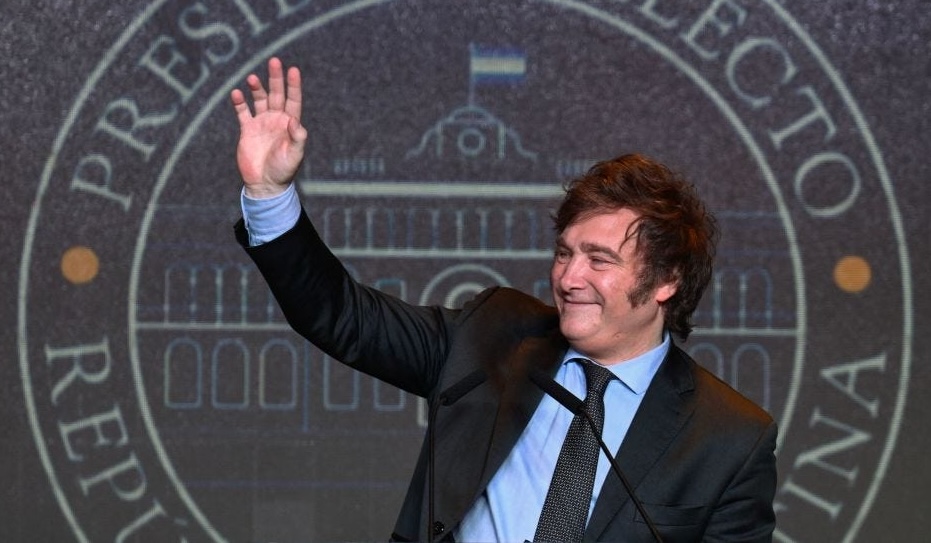
Will the election of Javier Milei as Argentina’s new president finally put the country’s economy back on track?
The Roar of the Argentinian Lion Read More »
Will the election of Javier Milei as Argentina’s new president finally put the country’s economy back on track?
The Roar of the Argentinian Lion Read More »
Last Sunday, Argentina experienced a political earthquake of major proportions. The libertarian economist, Javier Milei, won in a run-off election over another economist, Sergio Massa, the current Minister of Economy of the ruling party. The election has great significance for Argentina, the region, and even for Puerto Rico.
Javier Milei, Economic Liberty, and Puerto Rico Read More »
The recent election results in Argentina reminded me that several years ago, when I began my chairmanship of the Fiscal Oversight Board, I was summoned by a member of a local think tank to have a dialogue with Martin Guzman, a leftist economist and disciple of the Board's renowned critic, Nobel laureate Joseph Stiglitz.
Where Puerto Rico is headed Read More »
Economic freedom enables nations to raise their standards of living, health, knowledge, multicultural harmony, entrepreneurship, competitiveness, social progress and democracy. The top three leading nations in economic freedom are Singapore, Switzerland and Ireland. All are examples of growth and wealth creation. The worst are Venezuela, Cuba and North Korea, ranked 174th, 175th and 176th respectively, with impoverished populations and limited freedoms.
Economic liberty and growth: the strategy needed in Puerto Rico Read More »
Gradualism was already tried in Macri's government, and it was a complete failure. Argentina is in such a deplorable situation economically and socially, that the only thing that works are drastic measures. It is what is called shock therapy, which is nothing more than cleaning the rottenness of the system. Milei has an aggressive, categorical, radical discourse, where those responsible are very clear. And also, with the symbol of the lion, something to which few people have paid attention.
Liberalism won the cultural battle in the new generations Read More »
The election of Javier Milei as president of Argentina has generated emotional and diverse reactions. From rejoicing to see a libertarian stop the Peronist faction of Kirchnerism, to concern about the rise to power of another form of populism with extremist overtones. What has happened in Argentina is not surprising in view of the country's trajectory over the last century and should serve as a lesson for us, particularly for Puerto Ricans.
Parallels between Argentina and Puerto Rico Read More »
That, in a nutshell, is the story of the collapse of what was until a few decades ago the most prosperous nation in Latin America. In this story, we can replace the proper names and tell the same story of several nations in the region. Ecuador, in particular, can look in that mirror considering that we have also suffered the maddening effects of the oil bonanzas. Before the rise and fall of Venezuela, we saw the rise and fall of Argentina. After the Venezuelan story, we have seen in recent years what seems to be the beginning of the decline in Chile.
Economic freedom matters to economic development. Indeed, a wide body of empirical literature points to limited government, secure property rights, free trade, low regulations, and sound monetary policies as being generally associated with faster economic growth and higher income levels.
Economic Freedom Matters! More Than You Think! Read More »
Capitalism may be defined, as Carl Marx did, by its labor system, where the workers do not own their own means of production. It may also be defined by the metaphorical ‘market’ where the buying and selling takes place, or by private ownership of the means of production rather than government ownership. But my interest here is to describe capitalism as an attitude. That is, as a mental state connecting a person to a proposition.
The Young, and Capitalism as an Attitude Read More »
In Latin America, capital flight to the US financial system has long been the standard reaction to high taxes and fiscal profligacy, especially when governments add a penchant for monetizing the debt, devaluing local currencies and expropriating private property. Official dollarization, meanwhile, eliminates the option of devaluation, imposes a hard budget constraint on politicians, and introduces a strong rule‐of‐law element to the monetary sphere, as Professor Steve Hanke has argued.
Dollarization Beyond Argentina Read More »