
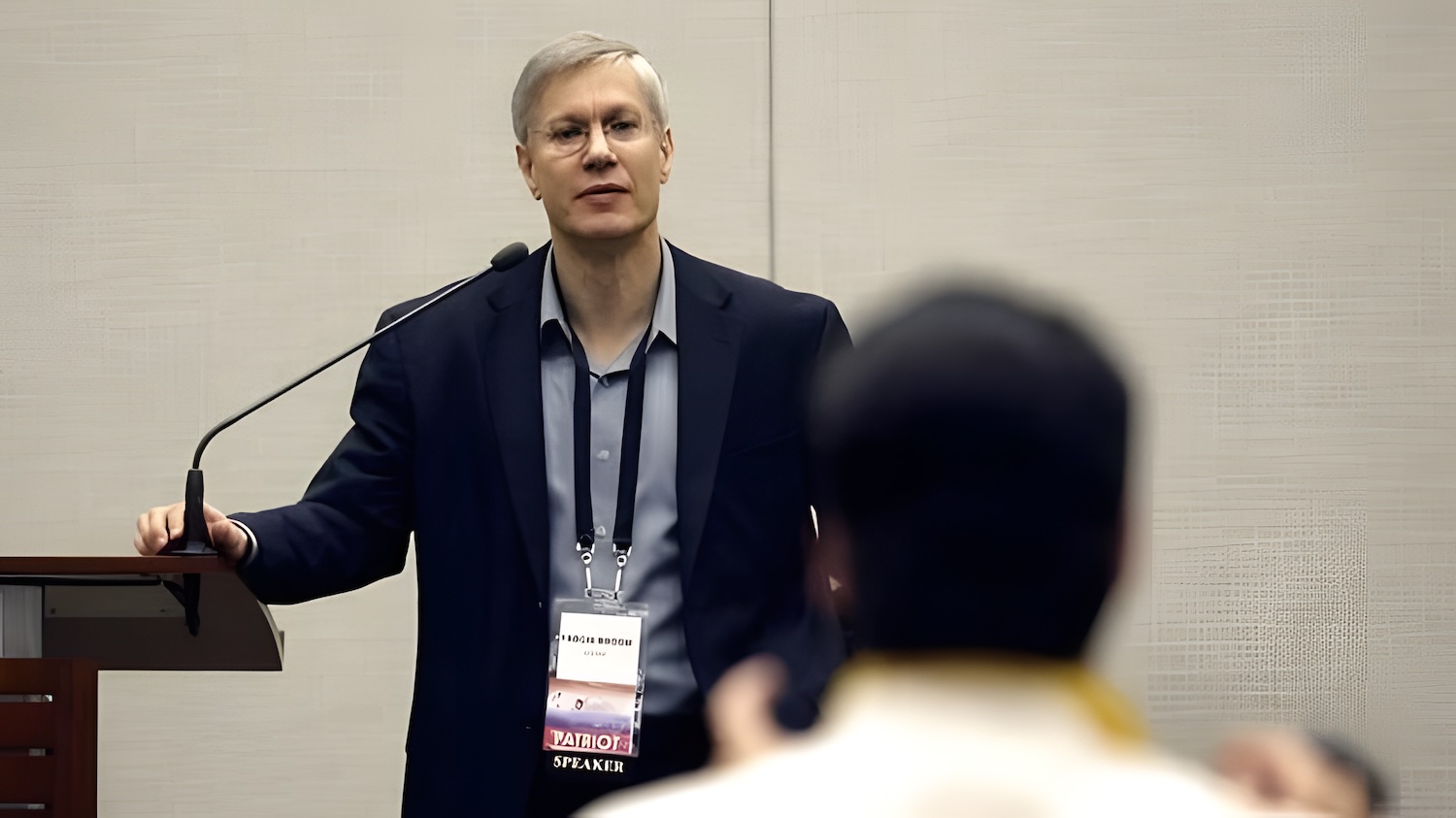
Yaron Brook Economist Yaron Brook shared his views on free markets and regulation with business leaders. (Facebook Yaron Brook)
The elimination of regulatory barriers and the reduction of the state's influence on economic activity are essential conditions for Puerto Rico to achieve sustained growth and generate long-term wealth, said Yaron Brook, president of the Ayn Rand Institute, during his speech at the VRM Penzini Capital Annual CEO Summit 2025.
From a historical and economic perspective, Brook argued that the prosperity of societies does not arise from government planning or public policies targeting specific sectors, but from economic freedom, entrepreneurship, and the ability to innovate without asking permission from the state. In his view, excessive regulation—more than taxes—is one of the main obstacles to economic development.
During his presentation, Brook posed a central question: how is wealth created in a society? To answer it, he traced a historical journey that showed how, for most of human history, income levels and quality of life remained virtually stagnant.
He explained that this pattern changed radically with the Industrial Revolution, when technological advances, access to more efficient energy sources, and, above all, a framework of greater freedom to undertake and produce coincided.
Brook emphasized that the emergence of modern economies was linked to systems where individuals could start businesses, invest capital, and develop ideas without depending on constant authorizations from political powers. In this regard, he highlighted the American model as a society founded on the idea of individual and economic freedom.
“Wealth is not created by politicians; it is created by entrepreneurs,” Brook said, asserting that the best contribution the government can make to economic development is to refrain from unnecessary interference in productive activity. He recalled that the United States was born as a country out of a movement by entrepreneurs.
The economist is president of the Ayn Rand Institute, a think tank that promotes free market ideas. He hosts The Yaron Brook Show and is a frequent commentator on radio and television in the United States. He has been a columnist for Forbes and has been published in media outlets such as The Wall Street Journal and USA Today, in addition to being the author of several books on economics and public policy.
Regulation, permits, and the cost of doing business
One of the most critical points of his speech was the impact of regulation on wealth creation. Brook questioned the need for lengthy and complex permitting processes, which he said raise costs, delay investment, and discourage innovation.
In his view, reducing permitting times from several years to a few months is insufficient if the goal is to unleash entrepreneurial potential. “The real question is why we need to ask permission for so many things,” he said, insisting that many economic activities could be carried out without such extensive state supervision.
Brook warned that development models based on temporary tax incentives or the selection of “winning” industries tend to generate fragile growth, dependent on political decisions that can change over time. He cited the example of the incentives provided by Law 90 and questioned how sustainable economic activity based on that model is.
Instead, he proposed removing structural barriers and allowing new industries to emerge—including those that cannot be anticipated today—driven by creativity and private capital.
International examples of economic liberalization
As part of his analysis, Brook cited examples of countries and territories that achieved rapid economic transformation through the liberalization of their economies, including South Korea, Taiwan, Singapore, and Hong Kong, as well as specific regions of China following the creation of special economic zones.
In all these cases, he argued, the pattern was similar: fewer state controls, less regulation, and more room for private initiative, which allowed for a rapid increase in productivity, investment, and quality of life.
Applying this to the Caribbean context, Brook argued that Puerto Rico and other islands in the region have sufficient geographical and human advantages to aspire to more ambitious economic development, provided that a culture that values entrepreneurship and reduces dependence on government control is adopted.
Secretary of DDEC: Permit reform as a public policy priority
From a public policy perspective, Sebastián Negrón Reichard, Secretary of the Department of Economic Development and Commerce (DDEC), addressed the government's efforts to reform and modernize the permitting system, one of the private sector's main demands and a key factor in attracting investment.
Negrón Reichard highlighted the need to simplify processes, reduce duplication, and speed up evaluations, with the aim of improving Puerto Rico's competitiveness vis-à-vis other jurisdictions, without sacrificing environmental or safety criteria.
The official framed the permit reform as an essential component for enabling projects in strategic sectors such as energy, manufacturing, technology, and infrastructure, and as part of a broader agenda to modernize the government apparatus.
Although their approaches differed, Brook and Negrón Reichard's remarks coincided on a common diagnosis: bureaucracy and regulatory slowness have a real economic cost, which translates into projects that do not materialize, capital that moves to other jurisdictions, and lost opportunities for growth and employment.
The discussion took place before an audience composed mainly of businesspeople, investors, and executives.
This article was published originally in Spanish by Metro.